TREK ITINERARY
Expedition to Everest Region – March/April 2012
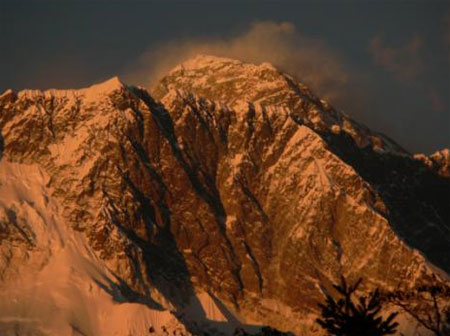 This is our biggest ever Everest Trek. We hope to get to the Chukung Valley, where some of our members will have a go at Island Peak. We will continue on from there to the Everest Base Camp. From EBC some of our members will cross the Choyola Pass to the Gokyo region whilst others will descend via Pangboche and Phortse and the conventional route into Gokyo. We will stay at the Gokyo Lakes for three nights if possible, ennabling us to walk out along the glacier and have a crack at Gokyo Ri. Sound good? Read on.
The trek will start in Kathmandu on March 20. We will spend a day getting organised with trekking permits, buying gear, banking, getting to know each other and holding a pre-trek briefing so that you know what to expect out there. On March 22 we will fly up to Lukla, a spectacular flight and an even more spectacular landing. This will leave you breathless unless you have nerves of steel.
We will walk up to Lukla in three days. The slower ascent puts us in much better shape on arrival at 3600 metres. We will spend a day acclimatising anyway, with a day-walk out to Thamo – Thame for the more adventurous! Then its onwards and upwards via Kangzuma, Phunki Tenga, Thangboche, Devouche and Pangboche to Dingboche. Should take about 3 days. We will stay in Dingboche for two nights to acclimatise further. Some of our members will go on to stay at Chukung overnight and then meet with our climbing guide for an attempt on Island Peak. The rest of the group will plod, sensibly, on towards Everest Base Camp. Again, should take about three days.
I would hope to arrive at Gorak Shep in time to visit the famous EBC in the afternoon. We then try to sleep (difficult at this altitude) in order to rise before dawn to climb Kala Pattar. I hear the views are pretty dammed good even from the half-way point so there’s no need to kill yourself if it all gets a ‘bit much’.
While the ‘A Team’ go charging over the Choyola Pass, the ‘Sensible Team’ will be going cross-country via Pangboche and Phortse (I love this trail). We will ascend to the Gokyo region via the conventional route of Dole and Machermo. We hope to spend three nights up there.
We will descend via the interesting community of Kumjung for a look at the very first Hilary school. Then its back over the hill, possibly via Everest View Hotel (it is a really, really great view) to Namche and then two days back down to Lukla for our flight to Kathmandu.
We plan to do all this in 22 or 23 days. This programme gives us time to really have a proper look around. To pause when necessary, to adapt when we have to and to continue even if we have the odd delay here and there through weather or problems on the track.
 So far we have five confirmed participants, plus myself. As you can see, there is still PLENTY OF ROOM for last-minute entries. If you want to get a good international flight though (ex Melbourne or Sydney via Thai Airways is a great deal at the moment) it is time to get cracking. Of course a trek this size doesn’t come cheap. At $3600 you are covered for 30 days, ALL EXPENSES paid. Transfers, taxis, ALL meals, snacks, hotels, trekking permits, insurance for your very own personal porter, park entrance, internal flight to and from Lukla, accommodation everywhere, a Nepali guide, ME, in fact everything except alcohol. And I have been known to buy a round of drinks! If you are comparing prices do check out the ‘food kitty’ on some other treks – it can be many hundreds of dollars. Some companies assume that you don’t want a porter – it is an extra cost when you get there!! Check out which meals are included. You might be surprised.
So here is our proposed itinerary. Of course it is not ‘written in stone’. We may need to adapt to conditions on the ground.
| MARCH 20 | Arrive in Kathmandu. Airport pick up and transfer over to Muna Cottage at Kapan. Over to Boudanath stupa for a ‘kora’ and dinner. |
| MARCH 21 | Chaos Day in Thamel. Permits. Banking. Trekking Gear. |
| MARCH 22 | Fly to Lukla early a.m. and walk to Phakding which is a tad lower. |
| MARCH 23 | Walk from Phakding to Jorsale. Up and down through farmlands. |
| MARCH 24 | Walk from Jorsale to Namche Baazzar. A bit steep but we should be there by lunchtime. Recovery afternoon, cruise the shops/bakeries. This place is truly ‘amazing’ nestled in a bowl surrounded by peaks. |
| MARCH 25 | Acclimatisation day. Walk out to Thamo or even Thame for the fit. |
| MARCH 26 | Walk to Kangzuma; a bit easy but well-located and good lodge. |
| MARCH 27 | Walk to Devouche. Not far but a steep climb over Thangboche./p> |
| MARCH 28 | Walk to Pangboche. Again, a bit easy but enough altitude for one day. |
| MARCH 29 | Walk up to Dingboche. At 4350 we will be starting to feel the altitude. Now we are in the Chukung Valley – really stunning below Lhotse Shar and the back of Amadablam. |
| MARCH 30 | Dingboche acclimatisation day. Walk to Chukung (optional unless you are planning to climb Island Peak). Alternative – Nangkar Tshang.
|
| MARCH 31 | Pheriche – fairly easy but enough altitude gain. |
| APRIL 1 | Lobouche. We are ascending slowly to avoid problems with altitude. |
| APRIL 2 | Gorak Shep: Everest Base Camp in the afternoon ?? These last couple of days could vary depending on our condition. |
| APRIL 3 | Kala Pattar in the morning and descend to Togla in the afternoon. We will try to reach the top of Kala Pattar early for great views of Everest. Climbers, or others, can go to Gokyo via Choyola Pass from here instead of descending. Personally, I find the trail from Pangboche to Phortse exciting enough. |
| APRIL 4 | Togla down to Pangboche. (there is an old village here not just lodges) |
| APRIL 5 | Pangboche to Phortse – I love this trek, rugged but great views |
| APRIL 6 | Phortse to Dole (to be confirmed) |
| APRIL 7 | Dole to Macherma ( ditto) |
| APRIL 8 | Macherma to Gokyo. Not being too specific here. Let’s see how we are travelling. It is all beautiful and not important where we make camp. |
| APRIL 9 | Gokyo again (walk out along the Glacier ??) |
| APRIL 10 | Gokyo again – climb Gokyo Ri ?? |
| APRIL 11 | Down to ......?? Not sure how long each section is here (my first time) |
| APRIL 12 | Kumjung. We can visit the first ever Edmund Hilary school. It is a really well-established Sherpa village with very sturdy stone houses in a sheltered valley of potato fields – views down to Thamserku and Ama Dablam. There is a lovely old gomba here and a Hilary clinic at Kunde. |
| APRIL 13 | Namche (we could skip this if time is short or we’ve used up our spare days already as its possible to get from Kumjung to Phakding in one rather long day. Of course, we will be ‘fighting fit’ by then. |
| APRIL 14 | Namche Baazzar down to Phakding. What a lovely easy downhill day. |
| APRIL 15 | Lukla . Our flights will be booked for tomorrow but could be varied if we are running behind schedule earlier in the trek. |
| APRIL 16 | Fly down to Kathmandu |
| APRIL 17 | Spare day (which we might have used up) |
| APRIL 18 | Spare day (might have used it, might need it for a flight delay??) |
| APRIL 19 | Kathmandu |
| APRIL 20 | Go home. |
We should get down to Kathmandu on 16th. If we do I can arrange for us to do all sorts of Interesting things (if we are not completely shattered). I would envisage a rest day, a shopping day and a couple of days of sightseeing – haktapur/Patan/Durbar Square/ Nagargot and walk down to Bhaktapur via Changu Narayan/Dulikel/Namobuddha..........all the above!!!! If you would like to join us then please email very soon.
teresadidi@slowtrekking.com or vonschwichtenberg@gmail.com
Cheers,
Teresa